 Welcome to the University of Washington! I’m Noah Smith, a computer science professor and AI researcher, and I serve as the UW’s vice provost for AI. As vice provost for AI, my job is to help the University’s leaders, faculty, staff and students make thoughtful, ethical and evidence-based decisions about the uses of artificial intelligence in the University context.
What Every UW Student Should Know About AI
The technologies we commonly call artificial intelligence (AI) are becoming part of education, work and everyday life. Many of this year’s incoming UW students who have used AI report that they learned largely through experimentation rather than formal instruction. Whatever your previous experience, your time at the UW is an opportunity to develop more deliberate, evidence-based judgment.
New technologies inevitably introduce high levels of uncertainty and change, and it is no different with AI. There are many claims about what AI can do or will be able to do, how it should or should not be used and what risks its use creates. Students come to the UW with different levels of access to and experience with AI. As you encounter these tools in your coursework and daily life, consider how they can support learning, accessibility and engagement. Building good judgment also means recognizing that students bring different experiences, resources and needs to their use of AI.
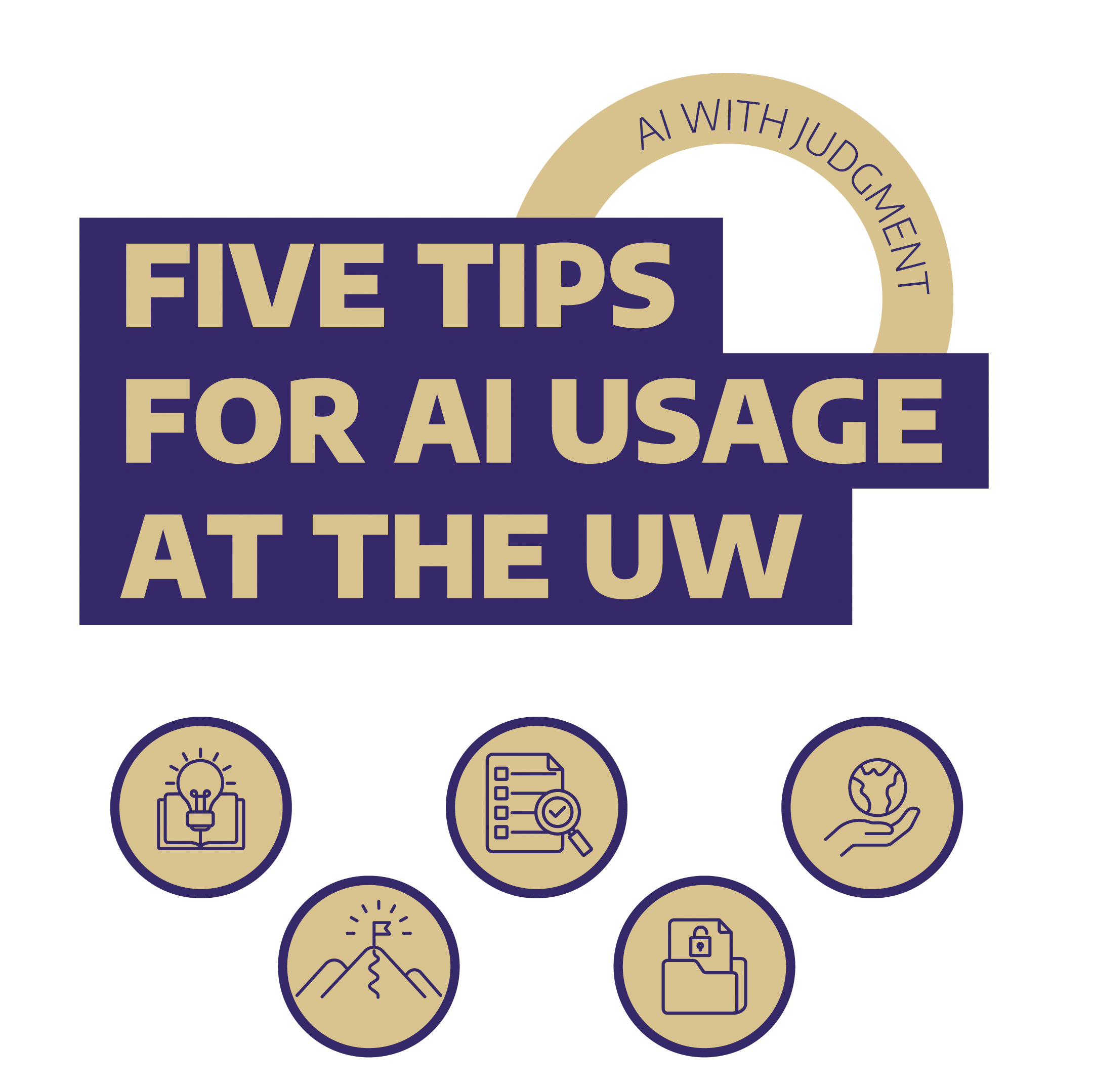
Developing AI literacy means learning to make thoughtful, ethical and evidence-based judgments about when and how to use these tools. Here are five habits that can help you build that judgment at the UW.
1. Put your learning first.
Many students report using AI to study, brainstorm or understand difficult concepts. Those uses can either deepen learning or bypass it, depending on how the tool is used. Do not let AI substitute for intellectual work that you need to practice yourself. A tool that makes an assignment easier may also leave you less prepared for future study or for the independent thinking required in your life and work.
AI can become a habit before you notice what skills you are giving up. Pay attention to whether it is helping you think or allowing you to avoid thinking. Ask yourself, “What am I learning by using this tool in this way, and what might I no longer be learning because of that use?” You worked hard to get to the UW; do not let AI hold you back or limit your learning.
The landscape of AI tools will continue to change during your time at the UW. Developing habits of critical thinking, ethical reasoning and curiosity will help you adapt no matter how the technology changes, and learning to recognize the difference between deepening and bypassing learning will be an ongoing part of your education and your citizenship.
Some of your most important learning will happen through conversations with classmates, faculty, mentors, librarians, advisors and other members of the UW community. AI cannot replace the relationships in which deep, genuine learning happens.
2. Understand what’s expected of you.
You and your classmates have already had diverse experiences with AI, ranging from required use to prohibition. At the UW, do not assume that the rules you encountered before will apply to the work in front of you.
It is your responsibility to understand the rules for each course, assignment and degree milestone. Different disciplines, courses and even different assignments within a course may set different expectations for AI use, because they are designed to achieve different learning goals. For graduate students, the same is true for degree milestones like qualifying exams, masters projects and dissertations. AI use that is appropriate in one setting may not be appropriate in another, and the tools and appropriate use will also change over time, so expect to adapt. When AI use is permitted, follow the rules for documenting or acknowledging that use.
There is a deeper question than “what is allowed”: what role are you meant to play in the work? Your education is an opportunity to develop your own creativity, curiosity, knowledge and judgment. AI can sometimes support that development, but it can also bypass it. When deciding how to use AI, ask what you are supposed to bring to the work, and whether AI is supporting that contribution or replacing it.
You are responsible for the claims you make and the work you submit, regardless of whether AI was used permissibly in creating that work. The UW’s standards of academic conduct apply to all of your work here, regardless of whether AI was used permissibly in creating that work. These standards are designed to protect your learning and the integrity of the education you chose to pursue by enrolling at the UW. Carefully read the guidance for each assignment and ask your instructor when you are uncertain. Your instructors are your partners and guides. When in doubt, ask them what tools to use or avoid, and ask them why. Instructors and programs have a responsibility to communicate AI expectations clearly, explain how those expectations connect to learning goals and provide reasonable opportunities for students to ask questions.
3. Check AI’s work.
It can be appealing to turn to AI systems, for fast answers to challenging problems. However, AI systems can produce inaccurate, misleading, incomplete, biased or false information, often in confident language. Again, you remain responsible for the claims you make and the work you submit.
Learn what it means for evidence to be reliable, and check important information against reliable evidence. Faculty, librarians and other mentors are here to help you with this learning. Do not fall into the trap of equating fluency with accuracy, and do not let an AI system replace your own judgment.
In the same vein, when you need guidance about decisions with important consequences for your health, well-being, academic progress or accessibility needs, turn to appropriate UW professionals and resources rather than relying on AI as a replacement for their expertise and judgment.
4. Don’t overshare.
Different AI tools handle data in different ways. Before typing information or uploading documents into an AI tool, learn and pay attention to where that information is going and how it may be used. In general, do not assume that information you enter will be treated as private or remain within the UW. Follow the UW’s guidelines about sharing sensitive, confidential or personally identifying information with AI systems. For those in the UW School of Medicine or UW Medicine more broadly, UW Medicine’s AI Policy will apply to your use.
If you are contributing to a research project led by someone else, make sure you understand and follow the project lead’s expectations, rules and constraints regarding AI use. Before uploading your own original research into an AI tool, make sure you understand how that material will be stored, used and protected.
Purple is the University of Washington’s enterprise generative AI tool. It offers a ChatGPT-like interface and allows users to interact with approved AI models. The UW provides Purple to students as a supported AI platform with additional privacy protections. However, access to AI does not replace the need for good judgment about when and how these tools should be used. Even Purple has limitations on what should be shared with it; Purple is not approved for use with Protected Health Information (PHI) or other UW Medicine data, for example.
5. Help shape what comes next.
Expect complexity in the conversation about AI. There is no single, settled view of AI at the UW. Different tools, uses, disciplines and situations raise different questions. AI, like many new technologies and practices, is a complex phenomenon. As learners and thinkers at a university, we seek to understand, navigate, negotiate and change the technical, ethical, physical and social implications of complexity all the time.
You are joining a community that is still learning how to design, build and use these technologies well, but not starting from scratch. Faculty, staff, students and researchers bring different forms of knowledge and experience to the questions AI raises, from understanding its impacts on the environment and economy to improving the technology itself, and the university is where those perspectives can come together to increase AI’s benefits and reduce its harms. Please bring curiosity, caution, openness and attention to evidence to that work. Developing good judgment about AI and other technologies will be part of your UW education and part of your preparation for life beyond the UW.
You will graduate into a society increasingly influenced by AI. Your UW education should prepare you not merely to adapt to these technologies, but to use your judgment, put people and learning first and help shape their effects on individuals, communities, and society.
I wish you all the best at the start of this new school year and look forward to engaging in future conversations as we shape the role of AI at the UW.
Download a poster of these tips Download a three-page booklet of these tips