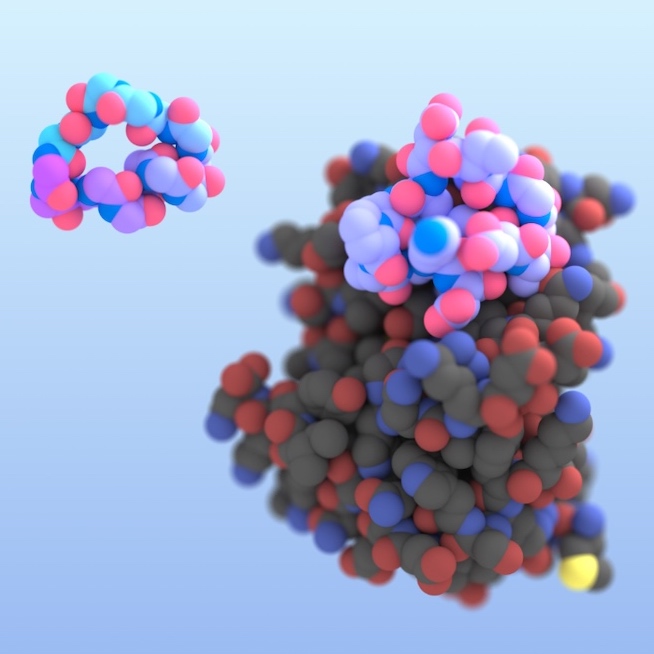
 Researchers at the University of Washington’s Institute for Protein Design have developed a generative AI tool that designs completely new bioactive peptides, which may accelerate drug development.
RFpeptides builds on the success of RFdiffusion, a generative AI that organizes amino acids into functional biochemical structures. Both of these projects draw inspiration from AI image generators that use diffusion models, such as Dall-E. RFpeptides expands upon its predecessor by ensuring that the first and last amino acids in a peptide chain form a chemical bond, creating a circular, and thus more rigid, structure. Ring-shaped peptides, or macrocycles, can bind to disease-associated proteins with only the structure or sequence of the target.
Traditional peptide design often requires extensive manual screening of peptide libraries to search for potential binders. With RFpeptides, researchers can input the target protein’s amino acid sequence and the generative AI creates customized peptides that have high affinity to their target. This development shows great promise for drug design as macrocycles can be customized by researchers, whereas normal peptides and proteins cannot.