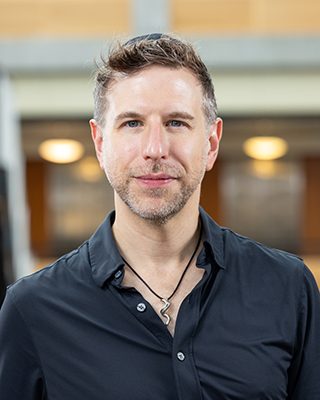
 As the UW’s first vice provost and endowed chair for artificial intelligence, Noah Smith is guiding the University’s efforts to further position ourselves as a model for how universities can responsibly and creatively adapt to the age of AI in our academic mission and in administration and governance. By leading the University-wide AI@UW initiative, vice provost Smith aims to accelerate innovation and collaboration, illuminate achievements, and propagate effective practices throughout the UW community and beyond.
In a three-part interview series, Smith addresses the University’s role and responsibility in the development and ethical use of AI, preparing students for careers and funding support for projects that explore how artificial intelligence can enhance teaching and learning.
In this first interview, Smith discusses the vision, purpose and scope of the AI@UW initiative that he is leading as vice provost for AI, and how faculty and staff can become involved.
What is the role of the University of Washington, as a public research institution, in the development and leveraging of AI to serve the public good?
The University of Washington, as a public research institution, must ensure that development and application of AI serves the public good. This means leading research in AI that serves humanity, addressing complex challenges that the market doesn’t (improving public health, supporting civic life, protecting the environment, expanding access to education, addressing climate change and enhancing social equity), and establishing governance frameworks to model informed and ethical policy.
Crucially, the UW must fulfill its public education mission by promoting broad AI literacy among students and university employees. It’s our job to democratize understanding and responsible use of AI technology.
What is the purpose of AI@UW and what is the scope of the initiative?
The UW must responsibly and creatively adapt to the arrival of the tools known as AI, across all functions, and AI@UW aims to make sure we do. This core purpose is achieved by accelerating innovation and collaboration, illuminating achievements of UW faculty, staff and students, and propagating effective practices throughout the UW community and beyond.
AI offers a new opportunity for universities like the UW to do what they’ve always done best: synthesize knowledge from many perspectives, challenge existing paradigms, and train the next generation of critical thinkers to address the most complex societal challenges.
Describe your role, vision goals as vice provost for AI?
I’ve been a professor for almost 20 years, and my research, teaching, and service duties have given me a partial picture of how a university goes about its business. As I begin this new role, I am focused on understanding how the University works at the highest level. I thank my colleagues for their patience while I catch up to our many experienced leaders and administrators!
Soon, I plan to combine what I am learning with what I know as an AI builder-researcher to guide the UW’s response to AI. From the outset, I want faculty, staff and students to see new technologies neither as a cure-all nor as an untamable, destructive force. Together, we get to decide how to use these tools, and we have the opportunity to find out how they can help us in our mission to preserve, advance and disseminate knowledge.
How will AI@UW support teaching and research faculty?
First, we’re launching the SEED-AI grant program to fund exploration and discovery in the use of AI to serve learning. I believe there’s great work already being done all around the UW, and this program is intended to accelerate and enrich such efforts and ensure that the whole UW community benefits from them.
In the longer term, we envision AI literacy as a core part of the curriculum for students. It’s also essential for faculty and staff, and we want to give them access to high-quality, up-to-date, scientifically-grounded information that will ease decisions they’ll inevitably face about whether and how to use AI in teaching, research, administration, and other UW work.
What resources will the initiative make available?
Of course, access to infrastructure (hardware, AI models that respect constraints on our data, etc.) is key, and we’re partnering with UW-IT work on that front. But to maximize our own control over the technology, we may need expert help. So we also hope to establish in-house AI expertise as a resource available to both education and research projects.
Finally, we need to find ways to connect people and projects across campus so that we don’t miss big opportunities that require collaboration. In concrete terms, we’ll start with events that bring people together around constructive uses and advances in AI.
Tell us about just a few of the amazing AI-based efforts you are seeing here at the UW.
I have to resist the urge to talk about work by my own students and collaborators, as amazing as I think it is. Please look at my webpage if you want to find out more about the world’s best truly open language models, new AI tools for musicians and more.
The Teaching@UW Network offers a course that hundreds of faculty have taken, “Using AI to Advance Learning.” In the face of new stresses for teaching, the folks in this course (and their instructors) are rolling up their sleeves, considering the evidence and looking for ways to move forward constructively.
Students and faculty in the UW Math AI Lab are working at the frontier where human mathematical creativity meets new AI tools. They’re showing how mathematicians can use AI not to replace insight, but to explore ideas more deeply, check complex structures and ask questions we might not have thought to ask. They’re exploring how rigorous, human-driven mathematics and modern AI can strengthen each other.
The work of Marine DeNolle, associate professor in Earth and Space Sciences, and her collaborators is a great example of what happens when deep scientific expertise meets modern AI. They use advanced computational and data-driven approaches to understand geohazards. They are engaging deeply to adapt the nuts and bolts of generative AI to accelerate domain-specific software and data.
Finally, I’ll mention Ben Lee’s innovative use of AI to preserve cultural heritage and make it more accessible. An assistant professor in the iSchool, Ben is developing new tools for navigating and curating multimodal collections. Though I’m not a humanities scholar, I believe this kind of work will make it easier for scholars across many fields to find and synthesize many kinds of information well beyond what a language model can read on the internet.
These are just a few examples I’ve encountered recently; as I said earlier, I’m in learning mode and looking forward to hearing about many more examples from my colleagues across the UW.
How can faculty, staff and students be a part of the conversation?
For now, I have two concrete items for faculty:
- Apply at ai.uw.edu for a SEED-AI grant to support your explorations of AI in your teaching. The deadline is February 1, 2026.
- If you are passionate about AI you can self-nominate to join the AI@UW advisory committee. You can also nominate a colleague!
For everyone:
- We’re planning an event this academic year to bring people together around AI in learning. Watch for information soon!